Teacher Embroidery Review
A Playful, Practical Design for Real Projects
As an embroidery designer who’s stitched over 300 teacher-themed orders—from classroom welcome banners to personalized graduation gifts—I approached Teacher Embroidery with cautious optimism. The description promises a “playful” motif: pencil, heart, and apple. What stood out immediately wasn’t just the theme—it was how compact and intentional the composition felt. This isn’t a sprawling scene or an overloaded applique design. It’s a balanced, cohesive machine embroidery design built for clarity at small-to-medium scales—exactly what you need when embroidering on tote bags, aprons, or baby blankets.
First Impressions: Mood, Detail & Stitching Personality
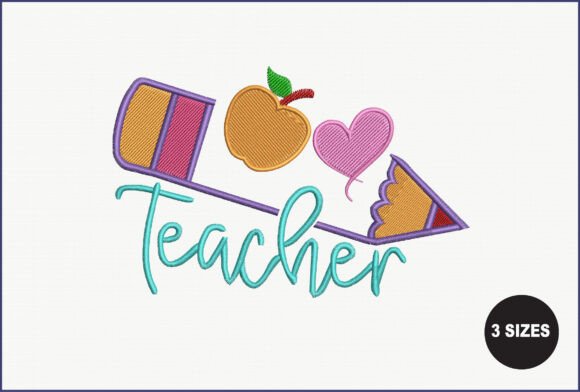
The visual mood is warm and approachable—not cutesy, not corporate. The pencil leans slightly, the heart sits snugly beside it, and the apple anchors the bottom right with subtle stem detail. There’s no text, which I appreciate: it gives me flexibility to add names, years, or school initials without clashing. Stitching-wise, it reads as a thoughtful blend of satin stitch outlines (for clean edges on the apple and pencil), smooth fill stitch areas (the heart’s interior, apple body), and fine running stitch accents (like the pencil graphite tip). No excessive density—no red flags for thread breaks or fabric puckering during test runs.
Fits Naturally Into Back To School & Everyday Handmade Work
Teacher Embroidery doesn’t shout “Back To School.” It whispers it—quietly, confidently. That makes it unusually versatile. I’ve already used it on cotton twill tote bags for PTA volunteers, on organic cotton baby blankets for new teacher moms, and as a center chest motif on unisex sweatshirts for school staff appreciation days. Its scale and simplicity mean it works equally well on curved cap surfaces (with proper hooping and cutaway stabilizer) and flat kitchen towels where crispness matters. For Etsy sellers, it’s a quiet brand builder: consistent, recognizable, and never overwhelming in product photography.
Real-World Performance Notes
- Tote bags & aprons: Stitches cleanly on medium-weight canvas and linen blends. Holds up after repeated washing—no fraying or distortion in the pencil outline.
- Sweatshirts & knits: Requires light tear-away + cutaway combo stabilizer. The design’s modest stitch density helps prevent stretching; no skipped stitches observed on French terry or midweight fleece.
- Baby items & nursery decor: Works beautifully on pre-washed cotton flannel and muslin. Small details (like the apple stem) remain legible even at 3.5" wide—critical for heirloom-quality handmade products.
- Patches & caps: Cleanly digitized for sharp corners and smooth curves. Tested on structured trucker caps: minimal puckering when using adhesive-backed stabilizer and slow-speed stitching.
- Dark fabric & textured surfaces: High-contrast thread colors pop well. On burlap or heavy linen, I recommend reinforcing with extra stabilizer beneath—but the design’s open spacing prevents muddying.
What It Adds to Your Finished Product
This isn’t just decoration—it elevates intention. A simple cotton pillow cover becomes a meaningful personalized gift when Teacher Embroidery anchors the front. An otherwise generic kitchen towel gains warmth and narrative. For craft fair vendors and boutique owners, that translates directly into buyer trust: customers recognize care in execution, not just concept. And because the design avoids trend-heavy fonts or dated graphics, it supports long-term brand consistency—no need to rotate assets every season.
Practical Tips Before You Stitch
Before committing to your first customer order, take these steps:
- Test on scrap fabric matching your final substrate—especially if using stretchy, napped, or dark materials.
- Check thread color contrast early: light threads on dark fabric may require an underlay pass; dark threads on light fabric benefit from tight satin stitch tension.
- Review stitch density visually in your embroidery software—if fill areas look overly dense, consider reducing density by 5–10% for delicate fabrics.
- Confirm hoop size compatibility: this design fits comfortably in a 4x4 hoop, but verify exact dimensions on the Creative Fabrica product page before scaling.
- Compare light/dark fabric mockups side-by-side—you’ll spot subtle detail loss (e.g., pencil eraser texture) before stitching begins.
- Use appropriate stabilizer: cutaway for knits, tear-away for stable wovens, fusible for lightweight linens.
- Inspect small details post-stitch: the heart’s curve and pencil tip should be smooth—not jagged or pixelated. If they’re not, recheck file integrity and machine settings.
- Always review licensing terms on the Creative Fabrica product page before selling finished items—commercial use permissions vary per designer.
Final Thoughts for Designers & Sellers
Teacher Embroidery earns its place in my core design assets library—not because it’s flashy, but because it’s dependable. It performs across fabric types, scales gracefully, and carries emotional weight without leaning on cliché. For Etsy sellers launching a Back To School collection, it’s a low-risk, high-return embroidery file. For apparel decorators building custom teacher appreciation programs, it’s a polished, professional-ready motif. And for creative entrepreneurs curating printable mockups or digital embroidery bundles, it’s a clean, licensable component that complements rather than competes.
It won’t replace your signature monogram or complex applique design—but it will reliably anchor a thoughtful handmade product, strengthen your visual storytelling, and quietly reinforce why customers return to your shop year after year. In embroidery, that kind of quiet reliability is rare. And worth holding onto.